· Cloud Migration · 5 min read
The CTO's Guide to Cloud Migration & FinOps
A deeply technical guide for executives on migrating legacy systems to the cloud, featuring Zero-Downtime dual-write architectures, Terraform FinOps tagging, and Agentic cost control scripts.

Moving to the cloud was supposed to be cheaper, faster, and infinitely scalable. Yet, in 2026, many CTOs look at their monthly AWS or GCP bills with a profound sense of dread. The promise of the cloud is absolutely real, but realising that promise requires a fundamental shift from hardware-centric thinking to software-defined infrastructure.
This comprehensive technical guide explores the exact architectures required for migrating massive legacy systems (like on-premise Hadoop) to the cloud with zero downtime, and the code required to implement a rigorous FinOps culture to prevent your cloud bill from destroying your profit margins.
1. Migration Strategies: Why “Lift and Shift” Fails
When migrating from an on-premise Hadoop cluster to AWS or GCP, the allure of the “Lift and Shift” (Rehosting) strategy is strong. You spin up 50 AWS EC2 instances, install Hadoop, and copy your HDFS data over.
The Reality: You inherit all of your legacy technical debt, and your costs skyrocket because you are renting expensive 24/7 cloud servers without utilizing elastic scaling.
The Cloud-Native Re-Architecture
To unlock the true power of the cloud, you must decouple compute from storage.
- Storage: Migrate HDFS to AWS S3 or Google Cloud Storage (GCS).
- Compute: Migrate Hive/Impala SQL workloads to Snowflake or BigQuery, and Spark workloads to ephemeral Dataproc or EMR clusters that spin up, execute the job, and terminate instantly.
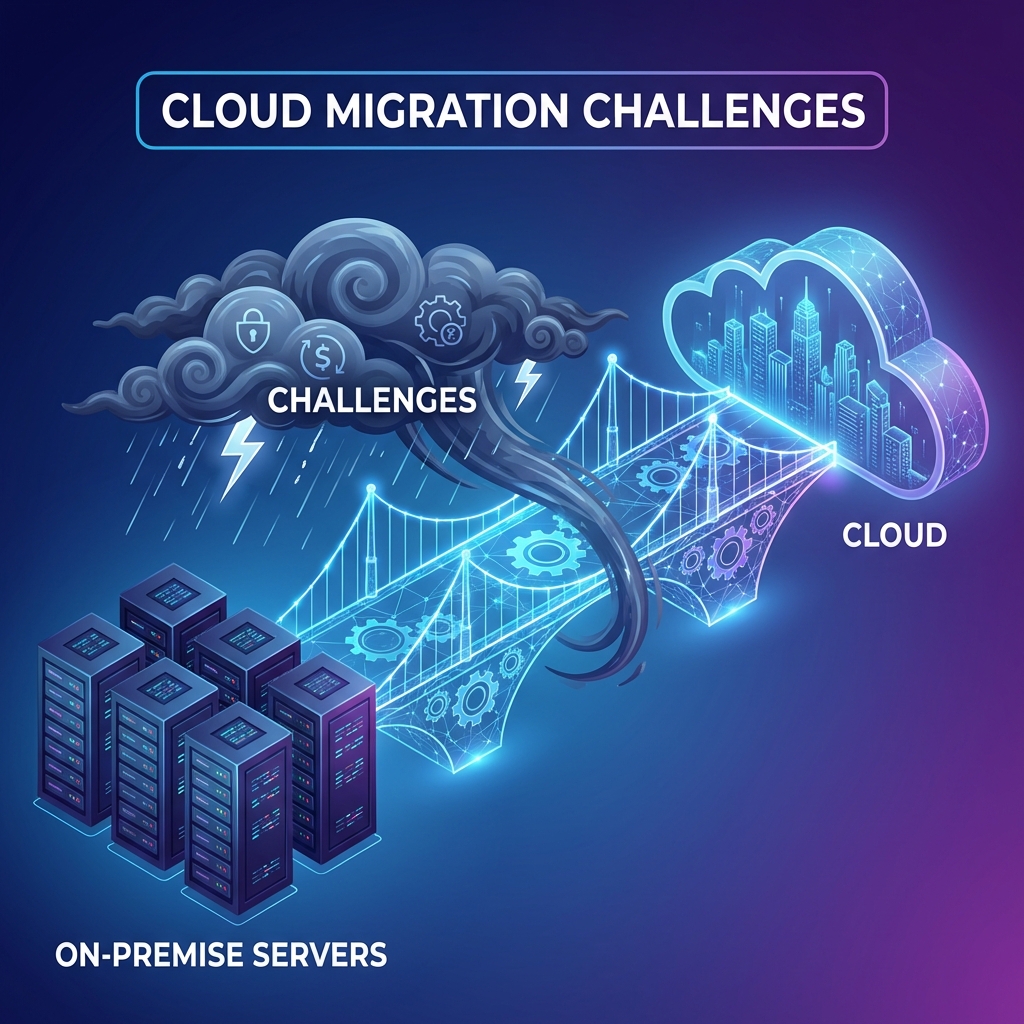
(Understand the full scope of these hurdles in Cloud Migration Challenges).
2. Architecture: Zero-Downtime Migration (Dual-Writes)
You cannot take an enterprise data platform offline for two weeks during a migration. You must execute a Zero-Downtime Migration. This requires a Dual-Write architecture where both the legacy system and the new cloud system run in parallel until data parity is verified.
The Dual-Write Architecture
graph TD;
    Source[Operational Databases & APIs] --> Kafka[Apache Kafka (Message Bus)]
    Kafka -->|Stream A| Legacy[Legacy On-Premise Hadoop/Hive]
    Kafka -->|Stream B| Cloud[Cloud Snowflake/BigQuery]
    Legacy --> Validation[Datafold / Data Validation Tool]
    Cloud --> Validation
    Validation -->|Parity Achieved| Cutover[Repoint BI Dashboards to Cloud]
The Process:
- Initial Sync: Snapshot the historical data and transfer it to the cloud via AWS Snowball or Google Transfer Service.
- Dual Ingestion: Configure Kafka to fork the data stream, writing to both the legacy cluster and the cloud Lakehouse simultaneously.
- Validation: Run automated parity tests on the outputs of both systems.
- Cutover: Repoint Tableau/Looker to the cloud warehouse and decommission the legacy cluster.
3. The Shock of the First Cloud Bill
The flexibility of the cloud means a junior engineer can accidentally spin up a $10,000/month GPU instance with a single line of Terraform code. This democratisation of infrastructure is why FinOps is a mandatory survival skill.
Enforcing FinOps Tagging via Terraform
You cannot optimise what you cannot see. The foundation of FinOps is a rigorous tagging taxonomy enforced at the infrastructure level.
Here is how you use Terraform to enforce mandatory Owner, Environment, and CostCenter tags on AWS resources. If an engineer tries to deploy a resource without these tags, the CI/CD pipeline will reject the build.
# main.tf
provider "aws" {
  region = "us-east-1"

  # Enforce default tags across ALL resources created by this provider
  default_tags {
    tags = {
      Environment = var.environment
      Owner       = var.team_owner
      CostCenter  = var.cost_center
      ManagedBy   = "Terraform"
    }
  }
}

# Example: If variables are missing, Terraform plan fails
variable "cost_center" {
  type        = string
  description = "Mandatory FinOps Cost Center ID (e.g., CC-9482)"
  validation {
    condition     = can(regex("^CC-\\d{4}$", var.cost_center))
    error_message = "The cost_center must match the format CC-XXXX."
  }
}
(Read our extensive guide on FinOps Tagging Strategies).
4. The Future: Agentic FinOps (Auto-Shutdown Scripts)
The manual process of a Cloud Architect checking AWS Cost Explorer once a month is obsolete. In 2026, the most advanced enterprises are using Agentic FinOps.
Instead of relying on human vigilance, you deploy autonomous Python scripts (via AWS Lambda or GCP Cloud Functions) that monitor infrastructure metrics 24/7 and take action.
Python Lambda: Auto-Hibernate Idle EC2 Instances
Here is a simplified Python script that uses boto3 to find expensive EC2 instances that have been running with less than 5% CPU utilization for over 12 hours, and automatically stops them to save money:
import boto3
import datetime

ec2 = boto3.client('ec2')
cloudwatch = boto3.client('cloudwatch')

def lambda_handler(event, context):
    # Find all running instances
    instances = ec2.describe_instances(Filters=[{'Name': 'instance-state-name', 'Values': ['running']}])

    for reservation in instances['Reservations']:
        for instance in reservation['Instances']:
            instance_id = instance['InstanceId']

            # Check CPU utilization over the last 12 hours
            metrics = cloudwatch.get_metric_statistics(
                Namespace='AWS/EC2',
                MetricName='CPUUtilization',
                Dimensions=[{'Name': 'InstanceId', 'Value': instance_id}],
                StartTime=datetime.datetime.utcnow() - datetime.timedelta(hours=12),
                EndTime=datetime.datetime.utcnow(),
                Period=3600,
                Statistics=['Average']
            )

            # If average CPU is below 5%, stop the instance
            if metrics['Datapoints']:
                avg_cpu = sum([dp['Average'] for dp in metrics['Datapoints']]) / len(metrics['Datapoints'])
                if avg_cpu < 5.0:
                    print(f"Stopping idle instance: {instance_id}. CPU was {avg_cpu}%")
                    ec2.stop_instances(InstanceIds=[instance_id])
                    # In a full Agentic system, this would trigger a Slack webhook to the Owner tag.

    return {"status": 200, "message": "FinOps sweep complete."}
(Read more about this cutting-edge approach in Agentic FinOps for Cloud Cost Optimisation).
Summary
Migrating to the cloud is a fundamental business transformation that requires treating infrastructure as code. By architecting dual-writes for zero-downtime, enforcing strict Terraform tagging policies, and deploying Agentic auto-shutdown scripts, you ensure the migration delivers true ROI without the bill shock.
Cloud costs out of control? Cut your GCP and AWS bills by 20% in 30 days. We help enterprises master their spend and migrate safely with zero downtime. Get a FinOps Audit today.